
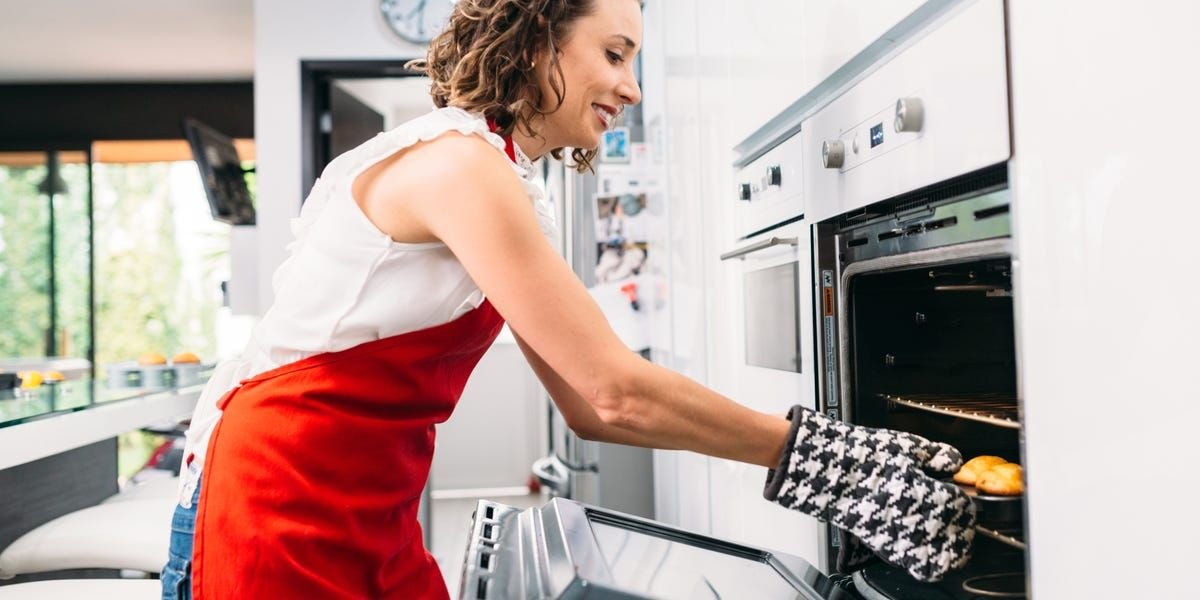
Alan also pointed out that the baking experiments used a toaster oven in an “average-sized” kitchen. “I wonder how applicable this is in homes with open layouts, which would be larger,” she said, in reference to the amount of toxins found in the air. Alan also called the sand and oil mix used to mimic food a “harsh” extraction method. “While this is interesting, I doubt that it will be 100% translatable,” she said.
Ultimately, “this is not a moment to panic,” Alan continued. “While [baking] conditions are similar, they are not identical. Second, they also found less silicone transfer with time. So, if you have been using a silicone product for a long while, it is likely safer to use.”
What are the safest types of cookware?
Again, the findings don’t suggest that silicone bakeware should be on your list of household products to toss right away. “For now, it is likely safe for people to use the baking tools of their choice—silicone, glass, ceramic—without concern for adverse health effects,” Dr. Johnson-Arbor said.
If you’re especially concerned, Alan suggested using glass bakeware. “The data is changing rapidly, but glass seems to be the least harmful product,” she said. “You could also consider lining baking sheets and pans with parchment paper.” Keep in mind that glass has its own potential issues. “Glass bakeware is generally chemically stable and does not leach into food, but it carries physical risks,” said Darin Detwiler, LP.D., a professor at Northeastern University and author of the book Food Safety: Past, Present, and Predictions. “If exposed to sudden temperature changes, it can shatter unexpectedly.”
Other options include stoneware and ceramic bakeware. “Stoneware and ceramic bakeware offer good heat distribution and are often made from natural materials,” Detwiler said. “However, glazed ceramics must be verified as lead- and cadmium-free and food-safe. Unglazed stoneware is typically inert but can absorb oils or odors, which may affect usability more than safety.” Another point: These are types of cookware that have been used for hundreds of years, so that should give some peace of mind.
To lower your risk of surface contamination that may be harmful, Dr. Johnson-Arbor recommended washing new baking items and kitchen utensils before using them for the first time. “It is also important to discard all peeling, chipped, or otherwise broken baking and cooking products or kitchen utensils, as damaged items can leach potentially harmful compounds, like heavy metals, into food,” she said.
If you have silicone bakeware you enjoy, Alan said you should be fine to keep on using it. “I would not recommend going out and replacing everything silicone,” she said. “You can evaluate based on your own products and replace as it makes sense for your household.”
For Complete Cooking STEPS Please Head On Over To Next Page Or Open button (>) and don’t forget to SHARE with your Facebook friends.
