
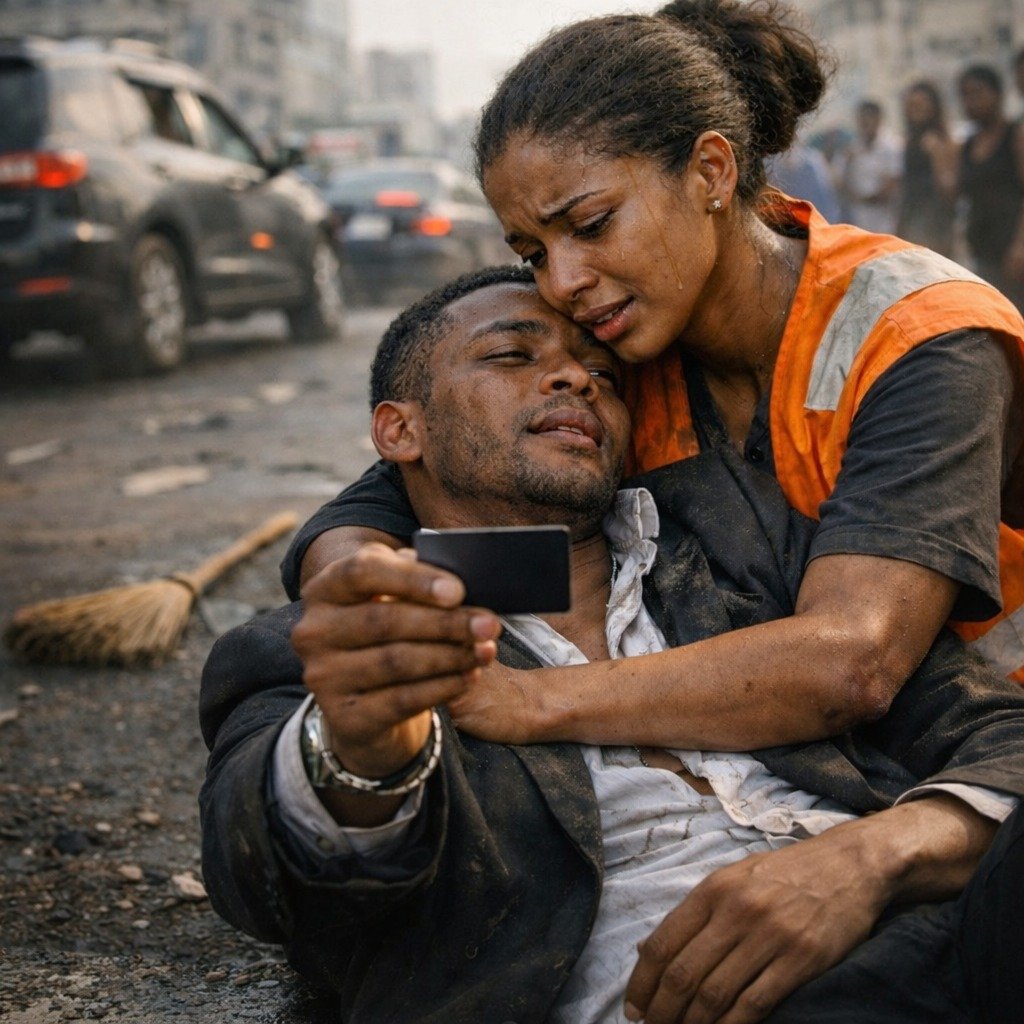
When the black SUV stopped beside the gutter, Ada did not look up at first.
She was halfway through the same stretch of road she had swept every morning for nearly three years, her broom moving in long patient strokes through dust, sachet wrappers, and the debris Abuja left behind after another restless night. Dawn had fully broken, but the city still wore that brief uncertain expression between exhaustion and ambition. Car horns swelled in the distance. A danfo bus coughed black smoke into the air. Somewhere nearby, a generator rattled like it had already given up on life but had no choice except to continue.
Then the engine of the SUV settled into silence, and the silence itself was expensive.
Ada lifted her eyes.
The rear door opened slowly. A man stepped out in a charcoal suit so perfectly tailored it looked sculpted onto him. He was young, maybe thirty-four, handsome in the polished magazine-cover way money often helps preserve. But illness had already begun rewriting his face. His skin held a gray undertone no healthy man carries. His lips were dry. His shoulders, though straight, looked like they were being held in place by nothing but pride. Even from several feet away, Ada could see what years of scientific training had taught her never to miss: the shallow breathing, the faint tremor in the fingers, the quiet panic of organs failing one by one beneath expensive fabric.
He walked toward her carefully, as though each step required negotiation with his own body.
“Good morning,” he said.
“Good morning,” Ada replied, resting both hands on the broom handle.
He studied her for a moment. Not with disgust. Not with pity. Not the quick dismissive glance she had grown used to receiving from drivers who saw her only as part of the roadside. He actually looked at her. At the orange municipal vest, the faded scarf around her hair, the calluses on her hands.
“You work hard,” he said.
“The street won’t clean itself.”
Something like a smile touched his mouth, but it broke apart under a sudden fit of coughing. His driver rushed forward. The man lifted one hand to stop him, though the effort cost him. Then, with the stubbornness of someone who had run out of time and therefore had no use left for caution, he reached into his jacket and placed a black metal card into Ada’s palm.
It was heavier than it looked.
She glanced at it. No printed limit. Just a name engraved in silver.
Obiora Nnamdi.
“What is this?” she asked.
“My personal card.”
“You’re giving your bank card to a stranger sweeping a roadside?”
He swallowed, steadying himself. “I’m giving it to someone who looks like she has earned more kindness than life has given her. Use it. Whatever you need.”
Ada looked at him then, really looked at him, and saw something that surprised her more than the card.
He was sincere.
Not performative. Not charitable for the sake of an audience. Not one of those rich men who wanted their generosity admired as loudly as their cars. He was dying, and death had stripped him down to the truth. In that stripped-down place, with almost no time left to lie to himself, he had chosen to offer relief to a woman he believed the world had ignored.
What he could not possibly know was that the woman holding his card could have bought his entire empire before breakfast and still returned to finish her shift.
Ada closed her fingers over the card. Then she took his wrist.
The driver stepped forward. “Madam—”
“Be still,” Ada said softly.
Something in her voice made him obey.
Two fingers rested against Obiora’s pulse. Thirty seconds passed. The city moved around them. A motorcycle whined past. Someone shouted over the price of tomatoes from across the road. Life, careless and loud, continued.
Then Ada released his wrist.
“You don’t have three days,” she said.
His expression changed. “What?”
“You have less than thirty-six hours. Maybe less. Your liver is failing fastest, but it won’t be what kills you. The cascade already touched your kidneys, lungs, and heart. The doctors told you to prepare, didn’t they?”
For the first time since stepping out of the car, fear entered his face without disguise.
“How do you know that?”
Ada turned the black card over once in her hand, then gave it back to him. “Because I know your disease. And because if you want to live, you should sit down before you fall.”
By the end of that morning, three world-famous specialists would stand speechless on a roadside in Abuja while a municipal cleaner in a reflective vest did what none of them could do.
And by the time the week ended, the same woman would walk into a ballroom full of people who had laughed at her, betrayed her, and called her worthless—and leave with everything they had once used to measure power burning quietly at her feet.
But that morning, all anybody could see was a woman with a broom.
That had been the plan.
For three years, Ada Okafor had chosen invisibility the way some people choose prayer. Deliberately. Daily. With discipline.
She woke every morning at 4:15 without an alarm because her body had long ago stopped needing one. The small flat she shared with her mother in Kubwa was always dark at that hour, the kind of darkness that made every sound sharper. The soft groan of the old ceiling fan. The drip of a tap that only sometimes respected being turned off. Her mother’s breathing from the next room, slow and deep with the exhaustion of a woman who had worked hard all her life and learned to sleep like she meant it.
Ada dressed in silence. Trousers. Shirt. Rubber boots. Faded scarf. No jewelry, no perfume, nothing delicate enough to be broken by labor or recognized by memory. Before leaving, she always paused at her mother’s doorway. Never long. Just long enough to confirm the rise and fall of the blanket. Long enough to reassure herself that Nkem was still here.
Then she picked up her broom and walked.
The city before dawn belonged to workers and strays. Women balancing goods for the early market. Security guards fighting sleep on plastic chairs. Bus drivers already irritated with a day that had barely started. Dogs with suspicious eyes. The occasional rich car slicing through poorer streets too fast, as if speed itself were a passport.
Ada walked twenty-two minutes to her assigned stretch of road, nodded to her supervisor, and began.
For most people, the work would have felt humiliating. That was because most people mistook visibility for dignity. Ada had learned otherwise at the very top of the world.
Before the broom, before the orange vest, before the dust and the cracked pavements of Abuja, Ada had been known across private channels by a title and never a face. She was the founder of the Citadel Group, a vast network of finance, biotechnology, defense, medical research, energy systems, diplomacy, and quiet influence spread across continents. Entire industries adjusted when Citadel moved. Governments denied depending on it while depending on it anyway. Markets rose, treaties held, vaccines accelerated, wars cooled, fortunes appeared, and decisions everyone called inevitable were often simply things Ada had approved before dawn.
Officially, almost nobody knew who led the organization. Publicly, the name most often attached to its unseen power was a myth more than a person: the Dragon Mother.
In private, behind encryption, proxies, and loyal intermediaries, the myth answered to Ada.
She had built her first laboratory at nineteen.
Published papers by twenty-two.
Held patents on medical processes in three countries before most of her peers had finished choosing careers.
Spoke four languages well enough to negotiate in all of them.
Made more money than old families, then made enough to buy the old families too.
And still, somewhere above all that altitude, she had developed a terrible hunger no wealth could feed.
She wanted to know whether anyone could love her without kneeling to what she owned.
She wanted to hear how ordinary people sounded when they spoke without fear.
She wanted to spend one full day in a room where no one was calculating what she could do for them.
So she stepped sideways out of her own life.
Not completely. The Citadel still moved under her direction. Secure calls still came. Orders still flowed through one trusted envoy, a sharp-eyed woman named Chinelo who was the only person on earth besides Ada’s mother who knew where the Dragon Mother spent her mornings.
But outwardly, Ada disappeared.
And the world helped.
It turned out that once a woman carried a broom, most eyes slid right over her. The same city that would one day bend under the force of her name barely noticed when she cleaned its gutters. Some days, drivers splashed muddy water close enough to stain her legs without apology. Some days, office workers crossed the road rather than pass too near her. Some days, people threw fresh litter onto the pavement she had just cleaned, as if testing whether the invisible had limits.
Her colleagues did not do that.
That was the first reason she stayed.
Mama Deji, loud and warm-hearted, who had buried a husband and still found a way to laugh.
Hauwa, who sold snacks on the side and never ate lunch without offering to share.
Brother Musa, quiet as evening, who fixed broken things without first making speeches about kindness.
They did not ask Ada why she was so educated in the way she spoke, or why her wrists were too fine for manual labor, or why her eyes sometimes looked like they belonged to someone who had seen too much of the world to be sweeping a roadside. They simply accepted her. Worked beside her. Teased her when she forgot to bring food. Saved her a seat under the nearest shade. Borrowed salt from her mother and returned it with gratitude.
Among them, Ada discovered something she had not found in boardrooms, embassies, or private compounds guarded by men with rifles: unperformed humanity.
It was there, ordinary and unfashionable, in shared groundnuts, in someone covering your section when your boots tore, in the way people who had very little still somehow practiced generosity without making a philosophy of it.
Then there was Emeka.
Five years earlier, before Ada began sweeping streets, before the Citadel became too large to breathe inside, she had met him in a season when she was tired enough to hope.
He was not rich then.
That mattered.
He was the son of a retired builder, ambitious but not yet transformed by success, trying to keep a struggling logistics company alive with borrowed ideas, borrowed confidence, and just enough stubbornness to be attractive. He had kind eyes at the time. Nervous hands. The habit of speaking too honestly when he forgot to protect himself. He made Ada feel, for a while, not adored exactly, but met.
When he proposed in the sitting room of her mother’s modest flat, kneeling with a ring he had obviously saved for at some personal cost, his voice shook. Ada said yes for the same reason. Not because the ring was small. Because the shaking was real.
He did not know who she was.
Not really.
He knew she came from a family with money. He knew she had an unusual mind. He knew she disappeared for days sometimes “consulting.” He knew opportunities often arrived around him after conversations with her. But when he once joked that she must be some kind of hidden business angel, Ada smiled and let the joke pass.
Then she began helping him.
Quietly.
A financing introduction here. A strategic restructuring memo there, passed through unnamed advisers. A market analysis that landed on his desk through a “friend of a friend.” A major investor who suddenly took interest in a company no one should have noticed. A legal maneuver that saved his expansion. A competitor neutralized before becoming dangerous. In meeting rooms, Emeka spoke with increasing confidence about instincts he thought were his own. His company grew. Then soared. Then became the kind of rising enterprise newspapers described as “one to watch.”
Ada watched it too.
She told herself she wasn’t lying. She was simply waiting. Waiting for the right time to see whether he loved the woman beside him or the future she could build around him.
People often say betrayal comes as a shock, but that is rarely true. It usually arrives first as a pattern. A new tone. A pause that wasn’t there before. A certain shame on somebody else’s behalf.
As Emeka became wealthier, he grew smoother. He learned the careful laugh rich men use when they want to seem humble without surrendering importance. He began correcting the pronunciation of restaurant names. Stopped eating at roadside spots. Started speaking of “standards” and “circles” and “the kind of life we must maintain.”
Then Ada took the municipal job and disappeared more fully into the life she had chosen.
At first, Emeka thought it was temporary. An experiment. A phase.
Later, he stopped pretending to understand.
The evening he came to end their engagement, Nkem was in the kitchen cooking jollof rice in the small pot she trusted more than any new cookware. Ada knew from her mother’s voice that someone unwelcome had arrived before she even entered the sitting room.
Emeka sat stiffly on the narrow sofa, expensive suit, expensive shoes, expensive discomfort.
He stood when he saw her, then thought better of it and sat again.
“I need to discuss something serious,” he said.
Ada lowered herself into the chair opposite him. “Then discuss it.”
He slid an envelope across the table.
Inside was a typed document ending their engagement.
Ada read every line. Her face did not change.
“So,” she said at last, placing it back down, “after five years.”
He leaned forward, relief and irritation struggling for space in his expression. “Ada, be reasonable. We were different people when this began.”
“That is usually true of time.”
“You know what I mean.”
She waited.
He exhaled hard. “I’ve built something now. My life is public. Investors watch me. Partners watch me. People ask questions.”
“And the answers embarrass you.”
He did not deny it. “What am I supposed to tell them when they ask what my fiancée does?”
“The truth would be a daring experiment.”
His jaw tightened. “This isn’t funny.”
“No,” Ada said. “It isn’t.”
He looked around the small room as if the walls themselves were arguing against him. “You are still sweeping roads, Ada. At thirty. You had every chance. Every advantage. I kept thinking you would stop and become… something.”
Her eyes held his without blinking. “Something respectable.”
“Something suitable.”
For a moment, all the old tenderness she had once felt for him stood up inside her like a person in a burning house, looked around, and understood.
Then he said the part that was worst not because it was cruel, but because it was rehearsed.
“I’m marrying Chiamaka.”
The room went still.
From the kitchen, the wooden spoon stopped moving inside the pot.
Ada folded her hands in her lap. “My sister.”
“She understands the world I live in now.”
“Your meaning grows clearer with every sentence.”
“She has connections. She introduced me to people at Citadel. Huge people. A regional director is backing my company now. There’s a signing ceremony at the wedding. This is bigger than emotion.”
Ada almost smiled, though not from amusement. “You are using my own organization to explain why I am too small for you.”
He stared at her as if she had spoken another language.
“I gave you your first serious investor,” Ada said quietly. “I created the strategy that saved your company. I built the plan that doubled your revenue. I opened every door you believe you forced with your own hands. I have been carrying you for five years, Emeka.”
He gave a short unbelieving laugh. “You’re delusional.”
“Call Alhaji Waziri Dangana.”
“What?”
“Call him. Ask why he invested thirty million naira in a weak company run by a man with no track record. Ask whose idea it was.”
He did not move.
Ada leaned back. “You won’t. Because some part of you already knows there were miracles in your career too precise to be luck.”
Color rose in his face. “I came here to end this cleanly.”
“Then leave cleanly.”
He stood. “The wedding is in three days.”
“I know.”
“I’m trying not to humiliate you.”
She looked at the unsigned document on the table, then back at him. “You are not trying very hard.”
When the door closed behind him, Nkem appeared in the doorway with the wooden spoon still in hand.
“He’s foolish,” her mother said.
“He’s vain.”
“That too.”
They looked at each other for a long second. Then Nkem asked the more important question.
“What are you going to do?”
Ada took out her phone and called Chinelo.
“Book the Transcorp Hilton,” she said when the line connected. “The whole place. Ballrooms, suites, kitchen access, everything.”
“Yes, ma.”
“Move the Citadel signing ceremony to that venue on the same day.”
“Yes, ma.”
“Send invitations to every head of state, every major investor, every person in Abuja who believes power must arrive dressed properly to count.”
A beat of silence. Then Chinelo, careful as always, asked, “Is this a wedding, ma?”
Ada glanced at the document on the table. “That depends on how honest people are prepared to become.”
Nkem returned to the kitchen. “Tell them,” she called out, “that if they ruin my pepper soup, I will sue the whole hotel personally.”
That made Ada laugh for the first time all evening.
The next morning, Obiora returned.
Not alone.
Three specialist physicians arrived with him in a procession of wealth and professional ego. Their verdict, after twelve tense minutes of examination, was the same one all the best hospitals had already given him: terminal multi-organ collapse tied to a rare inherited condition. No meaningful intervention available. Prepare the family.
Ada listened while leaning on her broom.
Then she opened the worn leather case she kept in her vest pocket and selected seven fine steel needles.
The doctors objected first with disbelief, then with offense. Obiora, pale and exhausted, silenced them all with a look.
“Do it,” he said.
So Ada did.
One needle at the base of the skull. One below the ear. Three precise placements along the chest over lines no conventional training recognized. One at the wrist. One between the brows.
For a few seconds nothing happened.
Then Obiora’s back arched. His breath tore out of him like a man surfacing from deep water. Color rushed into his face. The gray receded. His fingers unclenched.
He inhaled once.
Then again.
This time fully.
Alive.
The doctors checked him in disbelief. Then checked again. The impossible remained stubbornly true.
Obiora stared at Ada as though the whole shape of reality had changed and she alone seemed unbothered by it.
“Who are you?” he asked.
Ada rolled the needles back into their case. “A woman who still has three streets to finish before noon.”
She walked away before he could stop her.
Some people would call that moment the miracle. It was not.
It was merely the first witness.
Three days later, the Transcorp Hilton glittered like a public statement. Crystal chandeliers threw light over polished floors. Fresh flowers perfumed the lobby. Politicians, businessmen, old-money families, media figures, diplomats, and professional observers drifted through the ballroom in fabrics chosen to suggest importance without appearing to try too hard.
Chiamaka arrived dressed like victory. She was beautiful the way sharp things are beautiful—bright, deliberate, best admired from a careful distance. She had always been Ada’s opposite in the ways the world rewarded fastest. Social. Visible. Instinctively elegant. Their father’s second daughter, publicly preferred and privately indulged, shaped for rooms like this one from childhood.
Chief Okafor himself came in a wheelchair, worn thin by illness, his second wife at his side.
Emeka stood near the stage receiving congratulations he had not yet earned.
Then another set of guests began to arrive.
They came in buses, keke tricycles, and on foot. Municipal workers in their best clothes. Street sweepers. Sanitation staff. Men and women whose hands told the truth about how they survived. They clutched their invitations carefully, entering the marble-and-gold lobby as though it might reject them if they breathed too loudly.
Mama Deji gasped openly at the chandeliers.
Brother Musa kept smoothing the front of his shirt.
Hauwa held a small envelope containing a modest gift she could hardly afford.
And at the entrance, when security hesitated, Ada appeared.
She wore simple white.
No veil. No diamonds. No dramatic gown. Just a clean, graceful dress that made everyone else’s effort look suddenly nervous.
“They are my guests,” she said. “Let them in.”
The cleaners hugged her, laughing and crying and blessing her all at once. They took seats near the back at first, from habit more than instruction.
It did not take long for trouble to find them.
Emeka’s mother spotted their table and marched over with outrage already assembled.
She spoke loudly enough for half the ballroom to hear. Asked what “these people” were doing here. Said there were standards. Said this was not a union hall. Said if the sweepers stayed, there would be no wedding.
The cleaners began to rise awkwardly, shame arriving on old familiar feet.
“Don’t worry, my daughter,” Mama Deji said to Ada. “We will go. We don’t want trouble.”
Brother Musa nodded. “We know where people like us are usually allowed to sit.”
Hauwa looked near tears. “Please don’t spoil your day because of us.”
Ada stood very still for a moment.
Then she said, with a calm that cut cleaner than shouting ever could, “Nobody is leaving.”
Her voice crossed the room and settled over every table.
“I paid for this hotel. I chose every seat in this ballroom. These people are my guests. If anyone is uncomfortable, that person is free to go.”
A silence followed that was more shocked than respectful.
Then the ceremony began.
Or rather, what was supposed to be a ceremony.
Emeka took the microphone with the grim confidence of a man who believed the crowd belonged to him. He spoke of “difficult decisions” and “outgrowing old chapters.” He described his five-year engagement as though it had been an act of generosity on his part. He told the room, smiling in the right places, that he could not build a future with a woman who chose a broom over ambition. He announced that he was ending the engagement publicly and marrying Chiamaka instead.
Applause broke out.
Not from the cleaners.
Not from Nkem, whose hands had gone still in her lap.
Not from a few scattered faces who suddenly looked uncomfortable with themselves.
But enough applause to expose the room.
Chiamaka joined him onstage, satisfied, luminous, certain that humiliation was the final instrument needed to complete her victory.
Ada rose from her chair.
She did not rush. That was part of why the room quieted.
She walked toward the stage in white, unhurried and almost gentle, as if she were coming not to fight but to settle accounts.
“You said I am a failure,” she began. No microphone. None needed. “You said I wasted your years. You said I am beneath you because I sweep streets.”
Emeka folded his arms. Chiamaka rolled her eyes.
Ada looked directly at him. “Everything you built was built with my hands beneath yours. Every contract, every investor, every successful strategy you presented as your brilliance—I gave them to you. I made you possible because I loved you.”
A murmur moved through the room.
For Complete Cooking STEPS Please Head On Over To Next Page Or Open button (>) and don’t forget to SHARE with your Facebook friends.
